Purpose of the tool
Procedure
Settings
Interpretation guide
Forms of representation
Requirements
Tools
Examples
Terms
Formulas
-
Purpose of the tool
Type 2 (continuous) measurement system analysis is used to assess the suitability of a measurement system when multiple operators are involved.
The focus is on determining whether different inspectors obtain comparable results when measuring the same characteristic.
Type 2 MSA thus evaluates not only the repeatability but also the reproducibility of the measurement system.
-
Example tomato sauce:
For Type 2 measurement system analysis, the viscosity of tomato sauce is examined, as this measurement is performed by several employees during routine production.
First, 10 filled jars of tomato sauce are selected from the current production run.
The jars cover the relevant viscosity range of production and fall within the specification limits of 950 to 1050.
The rotational viscometer used in daily operations is employed as the measuring instrument.
The measurement conditions (measuring instrument, measurement method, temperature, and sample preparation) are defined in advance and kept constant throughout the entire measurement.
Three inspectors are selected for the analysis, who also perform viscosity measurements during normal shift operations.
Each inspector measures all 10 jars of tomato sauce once, with the order of the jars chosen at random.
After all three inspectors have completed the first round, a second round is conducted at a later time.
In this round, each tester measures all 10 jars again, again in random order. The two measurements by a single tester are not performed directly one after the other.
All measurement results are documented and assigned to the respective tester and part.
The recorded measurement values are then evaluated in AlphadiTab for Type 2 (continuous) measurement system analysis.
Explanation of the results:
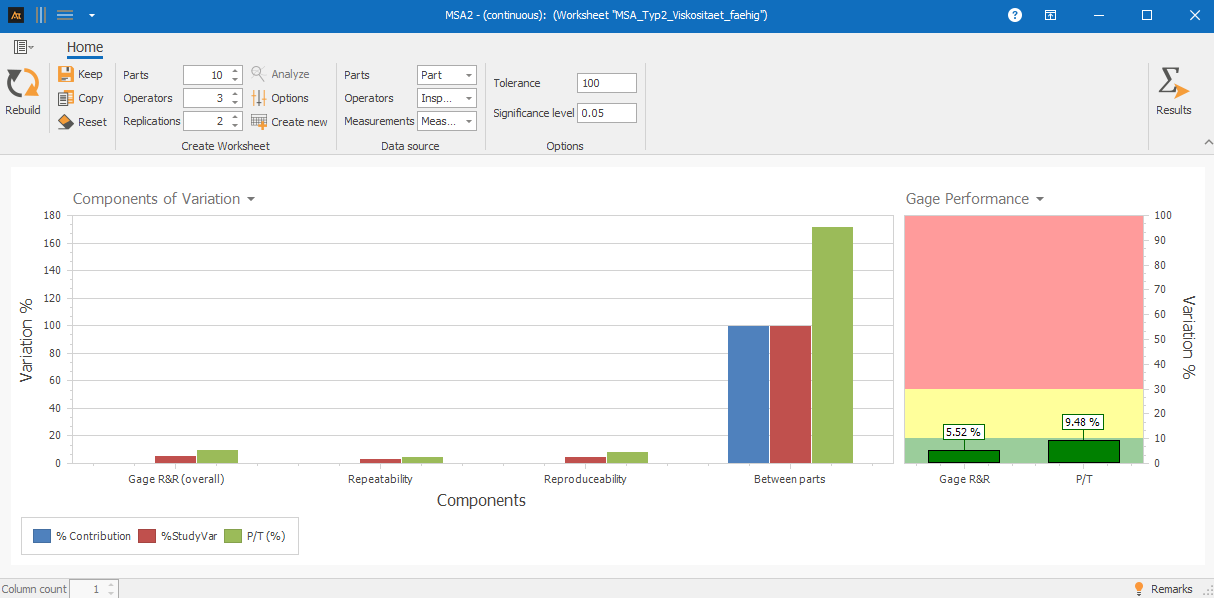
Type 2 measurement system analysis shows that the measurement system is suitable.
The proportion of measurement system variation (total Gage R&R) is 5.52%, which is below the guideline value of 10%.
Both repeatability and reproducibility contribute only slightly to the total variation.
The majority of the variation is caused by differences between the parts.
The P/T value of 9.48% confirms that the measurement system variation is sufficiently small relative to the tolerance.
The viscosity measurements can be used for further process and capability analyses.
Explanations of the graph:
Left image
The left diagram illustrates various aspects of measurement system variation.
- Blue bar (% contribution):
Shows the percentage contribution of each component to the total variation. - Red bar (6 × standard deviation):
Represents the variation of the respective component based on six times the standard deviation. - Green bar (visible only if a tolerance is specified):
Shows the proportion of the respective variation relative to the specified tolerance.
The components shown are:
- % Gage R&R (total measurement system)
- Repeatability
- Reproducibility
- Variation between parts
The first three components (%Gage R&R, repeatability, and reproducibility) describe the measurement system variation.
Ideally, these components should be less than 10%, as they should have little or no influence on the total variation.
The variation between parts describes the actual differences between the measured parts.
Here, it is desirable for the bars to be as large as possible. This indicates that the majority of the observed variation is caused by real differences between the parts and not by the measurement system.
Right image
The right diagram visualizes the two most important summary metrics of measurement system analysis:
- %Gage R&R:
Proportion of measurement system variation in the total variation. - P/T value (visible only if a tolerance has been specified):
Ratio of measurement system variation to tolerance width.
Both metrics should be below 10% for the measurement system to be considered suitable.
Higher values indicate that the measurement system has too great an influence on the measured results.
-
Procedure
Preliminary Work
- Select a continuous measurement parameter (e.g., viscosity).
- Determine a suitable measuring instrument.
- Select several different manufactured parts that cover the relevant characteristic range.
- Select several inspectors.
- Determine the number of repeat measurements per inspector.
- Define the measurement conditions and keep them constant.
- Create a worksheet for Type 2 MSA
- Perform measurements: Ideally, measurements are performed by inspector in random order; repeat measurements by a single inspector are performed at separate times.

Use in AlphadiTab
- In the Measure phase, consistently select the MSA Type 2 tool.
- Select “Inspector” for the operator.
- For “Part,” select “Part.”
- For measurements, select “Measured Value”.
- Enter the value 100 for “Tolerance”.
- Perform the analysis using the “Create New” button.
Interpretation
Check whether the measurement system is capable:
% Gage R&R < 10% → Measurement system is considered very good / acceptable
10% ≤ % Gage R&R ≤ 30% → Measurement system is conditionally acceptable depending on the application
% Gage R&R > 30% → Measurement system is not acceptable and should be improved
-
Requirements
Continuous measurement data
Continuous measurement data is required to perform a Type 2 measurement system analysis.
Why is this important?
Only with continuous measurement data can the repeatability and reproducibility of the measurement system be evaluated.
This data is collected using a measuring instrument and allows for a quantitative assessment of the measurement system variation.
Multiple produced parts
There must be multiple different, actual production parts available that cover the relevant characteristic range of the process.
Why is this important?
This is the only way to evaluate the influence of part variation on the measurement result.
Multiple inspectors (or a factor with multiple levels)
The measurements must be performed by multiple inspectors.
The inspectors represent the different levels of a factor (e.g., Inspector 1, Inspector 2, Inspector 3).
Why is this important?
In Type 2 MSA, in addition to repeatability, it is examined whether the measurement results differ between the levels of this factor.
In practice, this factor is usually the inspector, but it can also be replaced by other clearly distinguishable groups (e.g., locations or shifts).
Same measuring equipment
All measurements must be performed using the same measuring equipment, as the analysis evaluates the measuring system as a whole.
Constant measurement conditions
The sample, measuring equipment, inspector, and environmental conditions (e.g., temperature) must be kept constant during the measurement.
Why is this important?
Only under constant conditions can it be ensured that observed fluctuations in the measured values are attributable exclusively to the measuring equipment.
Normally distributed data
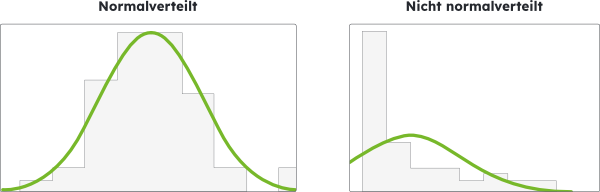
The repeated measurement values should show no indication of a significant deviation from the normal distribution, since the calculation of the metrics is based on assumptions of normal distribution
Why is this important?
In the event of a significant deviation from the normal distribution, %Gage R&R and %Tol do not provide reliable information about measurement capability.
The evaluation of measurement instrument variation can therefore become inaccurate or misleading.
-
Tools
(When are other options more suitable?)
If only a single inspector is to be considered and no differences between inspectors or groups are to be investigated, then a Type 1 measurement system analysis is appropriate.
If the measured values are not continuous data but rather ratings or categories (e.g., good/bad,pass/fail), then an attributive measurement system analysis (MSA Type 2 attributive) is more suitable.
If the capability of a process is to be evaluated rather than the measurement system, then a process capability analysis using Cp and Cpk is the appropriate tool. A prerequisite is a measurement system that has already been proven to be suitable.
-
Examples
Production / Quality Assurance
Net weight of tomato sauce
In tomato sauce production, the fill volume is regularly monitored.
The fill volume is specified as 500 ml.
For a Type 2 measurement system analysis, 10 filled tomato jars are sampled from the current production run.
Each jar represents one unit.
The fill volume is determined using a calibrated scale.
The conversion from weight to volume is performed using the known product density.
The measurements are performed by three inspectors:
- Inspector 1: Quality assurance employee
- Inspector 2: Production employee
- Inspector 3: Shift supervisor
Each inspector measures each of the 10 jars twice using the same scale under constant conditions.
The measuring equipment, measurement method, and environmental conditions remain unchanged throughout the entire measurement series.
Based on the measured values, it is assessed
- whether the inspectors arrive at comparable measurement results and
- how large the proportion of measurement system variation is relative to part variation.
Only when the measuring system is deemed suitable are the filling quantities used for further process and capability analyses.
Interpretation:
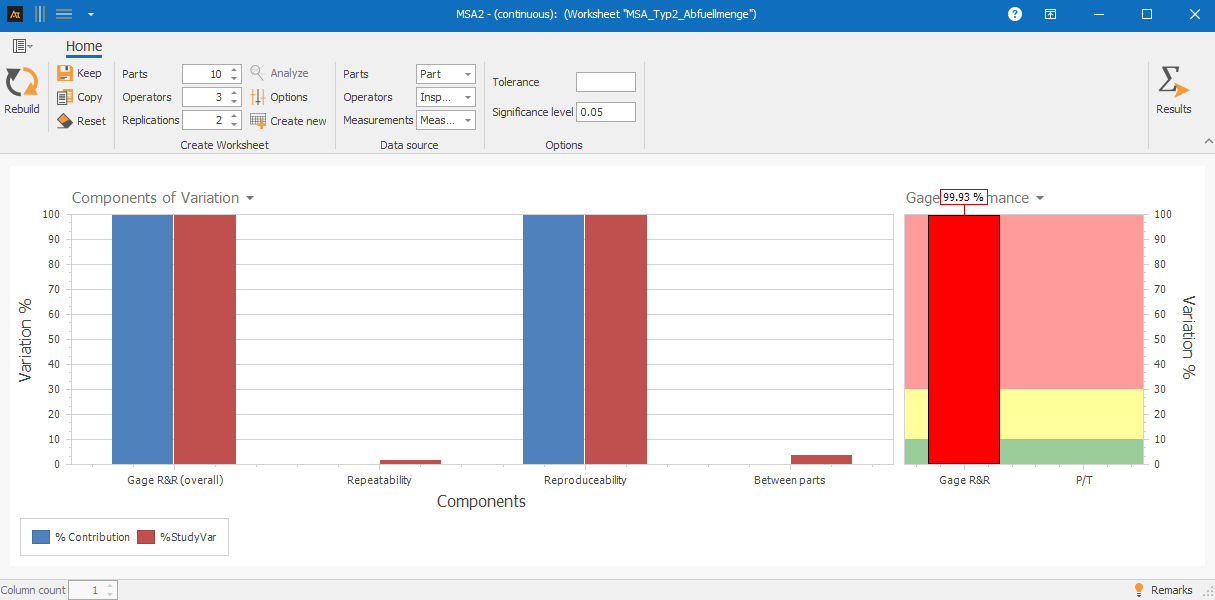
The evaluation of the Type 2 measurement system analysis shows that the measurement system is not suitable.
The proportion of measurement system variation (total Gage R&R) is 99.93%, which means it accounts for nearly all of the total variation. The actual differences between the parts cannot be reliably detected using this measurement system.
- Repeatability is good, as the variation within a single inspector is low.
The main cause of the high measurement system variation lies in reproducibility. There are significant systematic differences in the measurement results between inspectors. - The small proportion of variation between parts indicates that the part variation is masked by the measurement system.
The P/T value of 73.74% is significantly above the usual acceptance limits and confirms the measurement system’s lack of suitability.
In its current form, the measurement system is not suitable for evaluating the fill volume. Before the measurement data can be used further, the differences between inspectors must be reduced.
Typical measures
- Standardization of the measurement process
- Training of inspectors
Logistics/Receiving
Processing time for an order in the goods receiving area
The processing time in goods receiving is determined based on timestamps from the IT system, such as the time of physical goods receipt and the completion of the posting in the system.
The time values are therefore not recorded using a traditional measuring instrument, but are generated by the system.
For this reason, no formal measurement system analysis (MSA Type 1 or Type 2) is applicable to throughput times in goods receiving.
In particular, there is no measuring instrument in the traditional sense.
Nevertheless, it makes sense to apply the principles of measurement system analysis to this data.
In particular, it should be examined whether the data capture system used (e.g., scanner, entry form) causes systematic variations.
For example, different scanners, workstations, or entry types may result in varying timestamps.
Such a check helps determine whether observed differences in lead times are actually process-related or influenced by the method of data capture.
IT Support
IT Help Desk Response Time
The response time for the IT help desk is calculated using timestamps from the ticket system, such as the time the ticket was opened and the time of the first documented response.
Here, too, the data consists of automatically recorded timestamps rather than measurements from a physical measuring instrument.
Therefore, a traditional measurement system analysis is not directly applicable, as neither a measuring instrument nor an inspector, as defined by MSA, is involved.
Nevertheless, it makes sense to take the basic principles of measurement system analysis into account.
For example, one can investigate whether different ticket types, automatic status changes, or manual responses lead to varying timestamps.
This analysis allows for a better assessment of whether differences in response times are attributable to the actual process or arise from the system or its use.
-
Terms
Continuous data: Data collected using a measuring instrument that may include both units and decimal places.
Normally distributed data: Data that can be well described by a normal distribution. This can be verified, for example, using a normality test.
OSG = OTG = Upper specification or tolerance limit: The maximum permissible value for the target variable. If a measured value exceeds this limit, it is considered out of specification.
USG = UTG = Lower specification or tolerance limit: The minimum permissible value for the target variable. If a measured value falls below this limit, it is considered out of specification.
Measurement System Analysis (MSA): A procedure for assessing the suitability of a measurement system.
MSA Type 2 (continuous): Measurement system analysis to evaluate the repeatability and reproducibility of a measurement system using continuous measurement data.
Part: An individual, actual product that is measured as part of the measurement system analysis.
Inspector: Person who performs measurements.
Gage R&R: Proportion of measurement system variation in the total variation, consisting of repeatability and reproducibility.
Repeatability: Variation in measurement results when the same inspector measures the same part multiple times using the same measuring equipment.
Reproducibility: Differences in measurement results that arise when different inspectors measure the same part using the same measuring equipment.
% Tolerance = P/T: Proportion of measurement system variation relative to the specified tolerance range.