[tool_anchor_carousel]

Measurement System Analysis Type 1

  • Purpose of the tool

MSA Type 1 is used to assess the capability of a measuring instrument.
It checks whether a single measuring system measures
with sufficient precision (variation) and accuracy (position) during repeated measurements.

The key figures Cg (precision) and Cgk (precision + position) are used for this purpose.
A measuring device is often considered capable if Cg and Cgk ≥ 1.33 (or as specified).

  • Example: Tomato Sauce

In the production of tomato sauce, viscosity is monitored regularly, as it has a significant influence on consistency, filling behavior, and product quality.
The permissible specification limits for viscosity are 950 to 1050.

Before further analyses are carried out, it must be checked whether the measuring equipment used is suitable for determining viscosity.
For this purpose, a homogenized tomato sauce is used as a reference sample in a type 1 measurement system analysis.

The viscosity of the sample is measured several times with a rotational viscometer under constant conditions. The sample, measuring device, tester, and temperature remain unchanged in order to evaluate the repeatability of the measuring device.

Based on the repeated measurements, it can be assessed whether the measuring device can reliably measure the viscosity of the tomato sauce within the specified limits and is therefore suitable for further use in quality and process monitoring.

Measurement System Analysis Type 1

Interpretation of results:

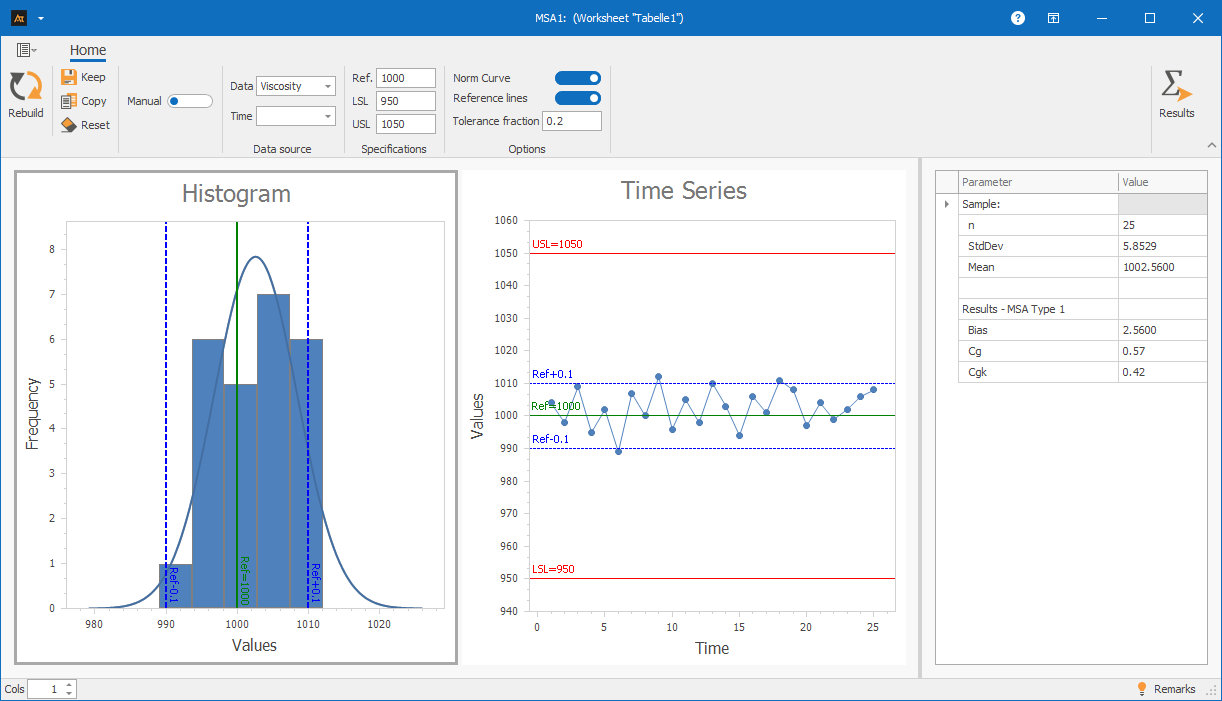
The type 1 measurement system analysis shows that the measuring equipment is capable. The Cg value is 0.57 and the Cgk value is 0.42, which is below the required minimum value of 1.33.
The measuring equipment exhibits excessive dispersion and shows a systematic deviation of 2.56.

Explanations of the graphs:

Histogram:

  • The bars represent the frequency distribution of the measured values.
  • The curve shows the normal distribution, which was calculated based on the mean value and the standard deviation of the measured actual data.
  • The dashed blue lines represent the reference lines. They are determined from the reference value and the specified tolerance percentage and are used to assess the dispersion of the measuring system in relation to the tolerance.

Time series diagram:

  • The red lines are the specification limits.
  • Procedure

Preliminary work

  1. Select a continuous measurement variable (e.g., viscosity).
  2. Select a suitable measuring device for determining the measured variable (e.g., rotational viscometer).
  3. Provide a reference part or reference sample (e.g., homogenized tomato sauce).
  4. Ensure that the specification limits are known (USG = 950, OSG = 1050).
  5. Define the measurement conditions and keep them constant during the measurement (same sample, same temperature, one tester; refer to the reference manual for the measuring instrument).
  6. Plan and perform a sufficient number of repeat measurements (e.g., 25 measurements).

Use in AlphadiTab

  1. In the Measure phase, call up the “MSA Type 1” function.
  2. Enter the “Viscosity” column for the data.
  3. Enter the reference value 1000 here, enter 950 for USG and 1050 for OSG.
  4. Click on the “Create new” button to perform MSA 1.

Interpretation

  1. First check whether the measuring device is capable (capable if the Cgk value is ≥ 1.33 or corresponds to the required minimum value).
  2. Then determine whether the position or dispersion of the measuring device (or both) needs improvement.
  • Requirements for this analysis

Continuous data

Continuous data is required to perform a type 1 measurement system analysis.

Why is this important?

Only with continuous data can the dispersion and position of the measuring instrument be evaluated. This data is collected exclusively with a measuring instrument and allows a quantitative assessment of the measurement capability.

Two specification limits

To calculate the Cg and Cgk key figures, both a lower and an upper specification or tolerance limit must be defined.

Why is this important?

Only with two specification limits can the dispersion of the measuring equipment be set in relation to the permissible tolerance range.

Reference part/reference sample

The analysis is based on repeated measurements of a single reference part or reference sample. This must remain stable throughout the entire measurement series and must not change.

Why is this important?

The aim of the analysis is to evaluate only the dispersion of the measuring instrument. If the reference sample is not stable, additional dispersion occurs that is not caused by the measuring instrument and distorts the result.

Constant measurement conditions

The sample, measuring equipment, tester, and environmental conditions (e.g., temperature) must be kept constant during the measurement.

Why is this important?

Only under constant conditions can it be ensured that observed fluctuations in the measured values are attributable exclusively to the measuring equipment.

Normally distributed data

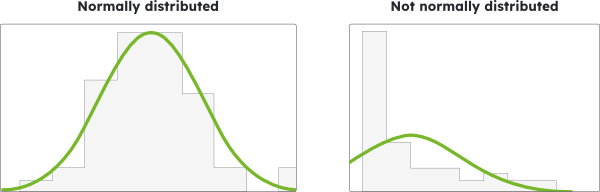
The repeated measured values should not show any indications of a relevant deviation from the normal distribution, as the calculation of the Cg and Cgk key figures is based on assumptions of normal distribution.
Why is this important?

If there is a significant deviation from the normal distribution, Cg and Cgk do not provide reliable information about the measurement capability.

This can make the evaluation of the measuring equipment dispersion inaccurate or misleading.
  • Tools

    (When are others more suitable?)

If the data are ratings (e.g., good/bad, OK/not OK, grades), then an attributive measurement system analysis (MSA Attributive) is more suitable.

If, in addition to repeatability, the influence of different operators (testers) on the measurement results is also to be investigated and the data is continuous, then a type 2 measurement system analysis (continuous) is more suitable.

If the performance of a process is to be evaluated, then a process capability analysis with Cp and Cpk is the appropriate tool. A prerequisite is a measurement system that has been proven to be suitable.

  • Examples

Production

Filling quantity tomato sauce

In the production of tomato sauce, the filling quantity is a key quality characteristic and is specified in milliliters for each product.
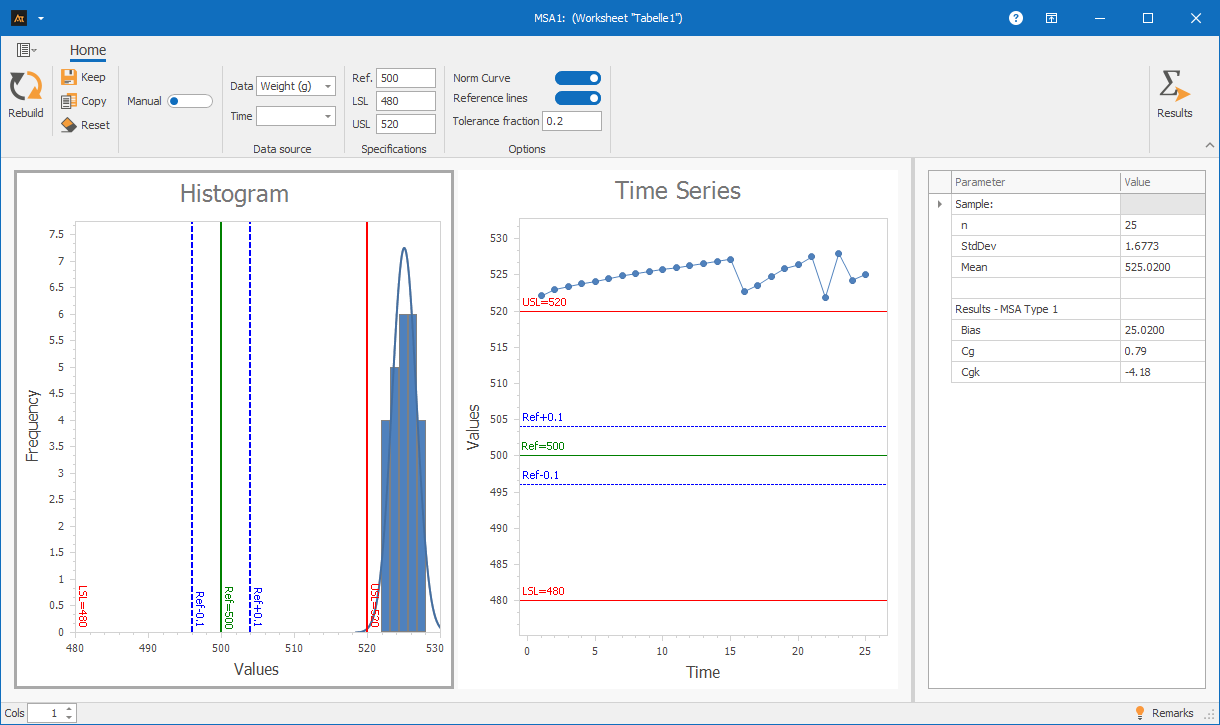
A target filling quantity of 500 ml is defined for the product, with specification limits of USG = 480 ml and OSG = 520 ml.

In practice, the filling quantity is monitored using a calibrated scale.
Since the measuring device records the weight, the type 1 measurement system analysis is performed based on the weight data. Since this is a fictitious example, it is assumed for simplicity that 1 ml of tomato sauce corresponds to 1 g.

As part of MSA type 1, a stable reference container is weighed several times under constant conditions (same container, same scale, one tester).
The aim is to check whether the measuring equipment used can record the filling quantity with sufficient precision and without any relevant systematic deviation.

The evaluation results in a Cg value of 0.79 and a Cgk value of -4.18. Both values are below the frequently required reference value of 1.33.

Interpretation

The measuring device is not capable.

Logistics/Goods Receipt

Processing time for an order in goods receipt

The throughput time in goods receipt is determined from time stamps in the IT system, for example, from the time of physical goods receipt and the completion of the posting in the system.
The time values are therefore not collected using a traditional measuring device, but are generated by the system.

For this reason, no formal measurement system analysis (MSA Type 1 or Type 2) can be applied to throughput times in goods receipt.
In particular, there is no measuring equipment in the traditional sense.

Nevertheless, it makes sense to apply the measurement system analysis approach to this data.
It should be checked whether time stamps are set with a delay, whether postings are collected, or whether there are system-related time shifts.
Only when these influences are known can throughput times be correctly interpreted and assigned to the process.

IT Help Desks

Response time for inquiries

The response time in the IT help desk is calculated from the timestamps in the ticket system, such as when the ticket was opened and the first documented response.
Here, too, the data is recorded automatically and is not measured using physical measuring equipment.

Therefore, classic measurement system analysis cannot be applied directly, as neither measuring equipment nor inspectors are considered in the sense of MSA.

Nevertheless, it makes sense to consider the basic principles of measurement system analysis.
For example, automatic status changes, manual post-processing, or time shifts in the system can influence the measured response time.
Checking for such systematic effects helps to correctly classify deviations and avoid misinterpretations of process performance.

  • Terms

Continuous data: Data that is recorded using a measuring device and can have both units and decimal places.

Normally distributed data: Data that can be described well by a normal distribution. This can be checked, for example, by means of a test for normal distribution.

Upper specification limit (USL): The maximum permissible value for the target variable. If a measured value is above this limit, it is considered unacceptable.

Lower specification limit (LSL): The minimum permissible value for the target variable. If a measured value is below this limit, it is considered unacceptable.

Cg: Capability index that evaluates the dispersion of the measuring instrument in relation to the specification limits.

Cgk: Capability index that evaluates both the dispersion and the position of the measuring instrument in relation to the specification limits.

Bias (position deviation): Systematic deviation of the mean value of the measured values from the reference value.

Reference value: Specified or known target value with which the mean value of the measured values is compared.

x̄ = Mean value of the sample: Average value of the collected data.

s = Standard deviation of the sample: Measure of the dispersion of the data around the mean value.

  • Formulas

\( \mathrm{T}=\mathrm{OSG}-\mathrm{USG} \)

\( \mathrm{Cg}=\frac{0,2\cdot \mathrm{T}}{6\cdot \mathrm{s}} \)

\( \mathrm{Cgk}=\frac{0,1\cdot \mathrm{T}-\left|\bar{\mathrm{x}}-\mathrm{x}_{\mathrm{ref}}\right|}{3\cdot \mathrm{s}} \)

\( \mathrm{Bias}=\bar{\mathrm{x}}-\mathrm{x}_{\mathrm{ref}} \)